3 Yr Old Root Canal on Tooth Hurting Again
Table of Contents [Hibernate] [Evidence]
- What Is a Root Canal?
-
Is a Root Canal Condom?+ −
- So Who Is Right?
- The Problem with Lingering Bacteria
- Weston A. Price on Root Canals
- Back to the Bacteria
- Root Canals: What to Exercise?
- Pros and Cons of Getting a Root Canal
-
Alternatives to Root Culvert Treatment+ −
- Dental Implants
- Dental Bridge
- Fractional Denture
-
What to Do with Existing Root Canals+ −
- Get a Second Opinion
- Adapt Lifestyle Choices
- Root Canals: Bottom Line
Root canals are a controversial topic in the dental world (if you didn't know!). I've ever had a fascination with studying oral health, and while I'm glad to have never needed a root culvert (or an alternative), I felt it was good to research them and be prepared in case I e'er did.
Many dentists consider the root canal—a dental procedure to treat deep dental cavities—to be a safe process, while other inquiry has shown that root canals may allow dangerous leaner to grow in the mouth and the residual of the body.
What Is a Root Canal?
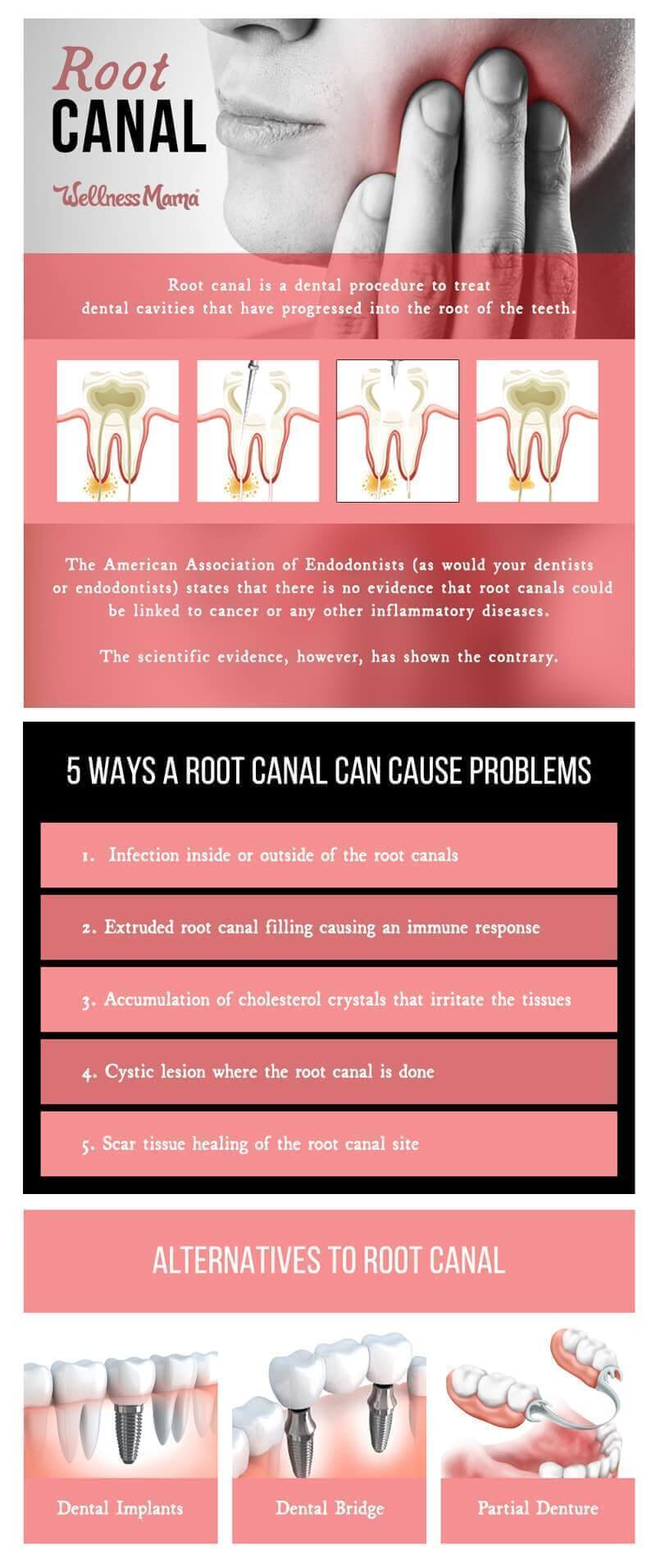
Root canals are recommended for dental cavities that accept progressed into the root of the teeth. The treatment of such cavities requires that all the infected pulp inside of the teeth be removed and cleaned, before the dental filling materials are injected into the tooth.
This allows the patient to proceed the tooth, although the living tissue inside of the tooth is replaced, and the tooth is considered expressionless.
Is a Root Canal Safe?
This is where things starting time to go confusing, and information technology really depends on who you ask.
On the ane hand, the American Association of Endodontists states that there is no prove that root canals could be linked to cancer or whatever other inflammatory diseases. On the other paw, some scientific evidence shows there could be a potential for some pretty serious issues.
So Who Is Correct?
Let'due south look at the information.
1 written report tested the effectiveness of root culvert cleaning procedures and constitute endotoxins and pathogenic leaner in 100% of root canals. The cleaning procedures can articulate upwardly to 44% of these bacteria, but the bacteria always persist.
The theory is that this could lead to long term problems, including some pretty serious ones. In fact, there are five ways that a root culvert can lead to problems, including:
- Infection inside or outside of the root canals
- Extruded root canal filling causing an immune response
- Aggregating of cholesterol crystals that irritate the tissues
- Cystic lesion where the root canal is done
- Scar tissue healing of the root canal site
Even afterward the root canal process is long over, it appears that bacteria tin (and often does) remain. This can logically lead to infections and other problems, and antibiotics are oft given if needed.
Withal, while antibiotic utilize presents its own side effects, one study has shown that antibiotic use does not significantly reduce pain and swelling. Overall, there is no stiff evidence suggesting that antibiotics really help with root canal infections.
The Problem with Lingering Bacteria
The bacteria (again, present in 100% of all root canals) can stimulate inflammatory molecules such as Interleukin-1beta and TNF-alpha, thereby raising inflammation throughout the body.
In severe cases, this tin cause fever, malaise, and abscess or cellulitis in the head and cervix area that may even crave hospitalization.
Even without major complications, the bacterial toxins and inflammation can lead to seemingly unrelated health problems, equally Dr. Weston A. Price discovered.
Weston A. Price on Root Canals
Dr. Price, a dentist known for his work on the relationship between nutrition and dental wellness (and overall health), was able to show that root canals can crusade chronic diseases of inflammation by experimenting on rabbits.
Here'south what he did:
He conducted a series of experiments on rabbits, using extracted teeth from people with diverse wellness problems. His enquiry institute that rabbits would develop the condition that the person with the tooth had.
In other words: when using a tooth from a person with eye attacks and arthritis, the rabbit implanted with the root canal tooth would develop heart attacks and arthritis inside a few weeks.
Back to the Bacteria
The leaner that are found within of root canals include groups of leaner called Fusobacterium, Parvimonas, Prevotella, Porphyromonas, Dialister, Streptococcus, and Treponema.
Many of these bacteria are naturally present in the rima oris, but they only become a problem when we are infected with them. When they grow in the root culvert, the anaerobic atmospheric condition inside the root culvert can cause these leaner to become more than dangerous. In add-on, the ecosystem of these bacteria tin can make them fifty-fifty more dangerous.
These bacteria, in the context of periodontal infections, are linked to many chronic inflammatory diseases:
- The bacteria Fusobacterium, Porphyromonas, and Treponema are linked to atherosclerosis.
- The bacteria Porphyromonas is linked to Alzheimer'south disease through its ability to create inflammation in the body.
- Porphyromonas, Treponema, and Tannerella are linked to poor blood sugar command and diabetes.
Considering these bacteria are transmissible, it explains why the verbal same diseases could be transmitted from humans to rabbits past tooth transplantation in Dr. Price's experiments.
This list of links betwixt root culvert bacteria and diseases is by no means exhaustive, but the literature has consistently shown that the infections of these bacteria in the mouth are linked to chronic inflammatory diseases.
Root Canals: What to Do?
After researching, I would personally choose not to get a root canal if I was ever told I needed one. At that place are some less well known alternatives, merely they also all present their ain challenges. The best option, of course, is to maintain optimal oral health as much as possible and hopefully never have to make this decision.
Pros and Cons of Getting a Root Canal
Unfortunately, when a tooth has progressed to the point of needing a root canal, at that place aren't any really smashing options. And fifty-fifty within the dental community, the recommendations vary widely. As this article explains:
Dentists who speak out against the prophylactic of root canals bring up three main concerns:
- There is no way to completely remove all the dead tissue from the molar
- There is no style to sterilize the tooth, thus leaving bacteria in the tooth
- The materials used to fill the hollowed out tooth leak and cause problems "downstream"
Those in the profession who claim that root canals are rubber merits:
- Enough of the tissue is removed
- The body'southward immune organisation can better get on top of any existing infection
- There are improved substances to fill the molar
- There are no other suitable options
Alternatives to Root Canal Treatment
As explained above, the bacteria nowadays in dental cavities can exist quite unsafe. Deep dental cavities should certainly be taken intendance of, especially those that have the potential to infect deeper in the jaw.
So if a root canal isn't the all-time choice, what is?
Some holistic dentists propose that if the dental cavities are deep, the molar should exist extracted with the periodontal ligament removed to forestall further infections. Of class, this leaves a person without a tooth, though there are now several options if a tooth has been removed, such as:
Dental Implants
The tooth with cavity is removed and replaced with a metal implant. Information technology still remains controversial whether the implantation of metallic to supervene upon the tooth can cause bug as this can raise the levels of such metals in the body and crusade an immune response.
Dental Bridge
This may exist a safer option than dental implants since the metal is not implanted into the gums in the same way.
Fractional Denture
A removable denture to supersede the extracted tooth is the to the lowest degree invasive option.
What to Practice with Existing Root Canals
There is plenty information (and plenty alien opinions) when it comes to root canals to make a person's head spin! Hopefully, the emerging research volition shed some calorie-free on the prophylactic of root canals in the future, but what about people who already have one or more?
Get a 2nd Opinion
A modern-solar day researcher, Dr. Boyd Haley at the University of Kentucky, completed follow-up research to Dr. Price'due south piece of work and his findings are telling:
Roughly 25% of the root culvert teeth studied had bacteria inside them which produced toxins that were adequately benign. 50% of the teeth studied independent bacteria within their construction that would challenge a healthy immune system. The final 25% of the teeth contained bacteria which produce toxins more powerful than botulinum (Important annotation, botulinum is widely recognized as the most toxic substance known to humans). This bears repeating. 25% of the teeth Dr. Haley studied contained a toxin stronger than the strongest toxin known to humans…
Many holistic health experts, including Dr. Mercola and many of his dentist colleagues, recommend removing the infected teeth and root canals, even if they await and feel fine. Dr. Haley, who did the above study, had his teeth with root canals removed later completing his study.
Because every dental procedure comes with a chance (not to mention the expense), information technology is all-time to consult a biological dentist who is well versed in Dr. Price's work. I would suggest the same when considering wisdom tooth removal or whatever other surgical dental procedure.
Adjust Lifestyle Choices
Thanks to mod lifestyles, nosotros all know that the incidences of center disease, Alzheimer'south, and diabetes are on the rise. Based on the research of Dr. Toll and Dr. Haley, it appears that root canals may contribute to a subset of the cases.
Personally, I'd choose to have a tooth pulled instead of getting a root canal if I ever had to brand the pick. I'd rather lose a tooth than have a risk of long-term inflammation and other atmospheric condition (of grade, once y'all've gotten a cavity, starting on a remineralization routine is a adept way to go along from needing a root canal in the time to come).
Some sources propose that if information technology isn't possible to avoid or remove a root canal, sure lifestyle factors may help mitigate whatever potential problem. In fact, these are things we should probably be doing anyway, including:
- eating a low inflammatory nutrition
- managing stress
- maintaining gut wellness
- using plant extracts like aloe vera, rosemary, or eucalyptus that have some antimicrobial extracts against leaner that infect the teeth and root canals. (Nonetheless, there is no clinical study demonstrating the safety and effectiveness of these substances in real homo root canals, as we however don't know how well these substances … or fifty-fifty antibiotics … can achieve the blood that flows in that area.)
- Cull prophylactic and effective dental products (similar Wellnesse toothpaste!) to maintain good oral health
Root Canals: Lesser Line
Root canals are a tough subject. There certainly isn't a articulate and completely safe solution. I remember all dentists would agree that the all-time scenario is to take swell oral health and avert ever needing this controversial procedure if at all possible.
For those who already accept or need a root canal, information technology may be helpful to find a trusted dentist to help explore the options.
Additional Reading & Resources
- 3 Questions to Enquire Your Dentist about Root Canals
- I Accept a Root Canal, What Are My Options?
- Understanding the Bug with Root Canals
This commodity was medically reviewed by Dr. Steven Lin, who is a Lath accredited dentist trained at the University of Sydney. With a background in biomedical scientific discipline, he is a passionate whole-health advocate, focusing on the link between nutrition and dental health. As e'er, this is not personal medical communication and we recommend that yous talk with your doctor or dentist.
What'south your have on root canals? Delight weigh in in the comments below.
Sources:
- American Clan of Endodontists, "Root Canal Safe."
- Grand. E. Vienna et al., "Effect of root culvert procedures on endotoxins and endodontic pathogens," Oral Microbiology and Immunology vol. 22, issue 6 (December 2007).
- P. Northward. R. Nair, "On the causes of persistent apical periodontitis," International Endodontic Journal vol. 39, issue 4 (April 2006).
- A. Cope et al., "Systemic antibiotics for symptomatic apical periodontitis and acute apical abscess in adults," Cochrane Reviews, June 2014.
- Analia Veitz-Keenan and Angela M De Bartolo, "Bereft prove of the effect of systemic antibiotics on adults with symptomatic upmost periodontitis or acute upmost abscess," Evidence-Based Dentistry vol. 15 (2014).
- E. L. Souza et al., "Macrophage cell activation with astute upmost abscess contents determined by interleukin-1 Beta and tumor necrosis factor alpha production," Journal of Endodontics vol. 40, issue 11 (Nov. 2014).
- José F. Siqueira, Jr. and Isabela N. Rôças, "Microbiology and Treatment of Acute Apical Abscesses," Clinical Microbiology Reviews, April 2013.
- V. Vengerfeldt et al., "Highly diverse microbiota in dental root canals in cases of apical periodontitis (data of illumina sequencing)," Periodical of Endodontics vol. xl, issue 11 (Nov. 2014).
- Byalakere Rudraiah Chandra Shekar et al., "Herbal extracts in oral health care – A review of the current scenario and its future needs," Pharmacognosy Review vol. 9, issue 18 (Jul-Dec 2015).
- C. Fernandez et al., "Identification of Synergistetes in endodontic infections," Microbial Pathogenesis vol. 73, Nov. 2014.
nicholsonnuse1938.blogspot.com
Source: https://wellnessmama.com/139664/root-canal/
0 Response to "3 Yr Old Root Canal on Tooth Hurting Again"
Post a Comment